
How Media Buying Agencies Can Identify High-Spend Advertisers (2026 Guide)

Author
Aaron M
Media buying agencies identify high-spend advertisers by analyzing ad volume, creative duplication, funnel complexity, geographic expansion, and advertiser history inside the Facebook Ads Library. Tools like AdsLeadz help extract structured data, contact details, and similar-ad signals to prioritize brands most likely spending $10K–$500K+ monthly.
If you’re a media buying agency, your economics are simple:
- 3 clients spending $50K/month = stable growth
- 30 clients spending $3K/month = chaos
High-spend advertisers have budget flexibility, test aggressively, care about scaling, and understand ROAS. Most importantly — they already believe in paid traffic.
The challenge is not convincing them ads work. The challenge is finding them.
The Problem: Most Agencies Target the Wrong Brands
Typical outreach looks like this:
- Scraped random Shopify stores
- Generic Apollo lead lists
- “We can help you scale ads” emails
But most of these businesses spend <$1K/month, don’t test creatives, run 1–2 ads inconsistently, and have no real funnel.
You don’t want “potential advertisers.” You want active, scaling advertisers.
Where High-Spend Advertisers Actually Leave Signals
The best place to detect serious ad spenders is the Facebook Ads Library.
It’s free. It’s public. It shows every active ad.
But most people don’t analyze it properly. Here’s what actually indicates serious budget.
7 Signals That Indicate a High-Spend Advertiser
1. Large Volume of Active Ads
- 1–3 ads → low spend
- 10–20 ads → mid-tier
- 50–200+ ads → serious budget
High-volume creative testing usually means multiple funnels, audience segmentation, and structured scaling. In performance marketing, creative testing is expensive. Brands don’t run 80 active ads for fun.
2. Similar Ad Clusters
When you see the same video with slightly different hooks, different CTAs, same product — that’s structured A/B testing.
High-spend advertisers systematically test hooks, angles, UGC variations, and landing pages. If a brand has 20 variations of the same creative, that’s a scale signal.
3. Long-Running Ads (90+ Days)
According to Meta’s internal performance studies (2024), ads that survive 60–90+ days often indicate profitable campaigns, stable CAC, and predictable LTV. If an ad has been live for months, they are likely spending consistently.
4. Multi-Country Expansion
High-spend brands don’t stay local. Look for US + UK + CA, EU clusters, GCC markets, AU + NZ. Geographic expansion strongly correlates with budget maturity.
5. Funnel Sophistication
Low-budget brand: traffic → product page.
High-budget brand: traffic → advertorial, retargeting sequences, lead magnets, email capture flows. If landing pages are custom-built (not default Shopify theme), that’s another signal.
6. Creative Quality Level
Look at high-production video ads, influencer UGC, motion graphics, multi-variant statics. Production budget correlates with ad budget. A $10K/month advertiser rarely invests in 30 polished creatives.
7. Similar Advertiser Network
If a brand appears alongside other scaling brands in the same niche, it often indicates a competitive paid environment. High CPM niches (beauty, supplements, fashion) naturally filter out small advertisers.
The Limitation of Manual Facebook Ads Library Research
Manually analyzing the Ads Library works for 5 brands, maybe 20. But not for 10,000.
You can’t export advertiser lists, filter by ad count, extract emails, or detect similar ads at scale. That’s where structured tools come in.
Even when you know what high spend looks like in the library, prospecting still depends on turning raw results into a clean list of advertisers. Meta does not give you a dedicated brand field—only page names, CTAs, and landing URLs—so the same company can appear under slightly different labels unless you normalize and dedupe deliberately. If you are building that layer yourself, see our step-by-step guide on turning those signals into usable records: How to Extract Advertiser Brands from Meta Ads Library (2026 Guide).
Using AdsLeadz to Identify High-Spend Advertisers
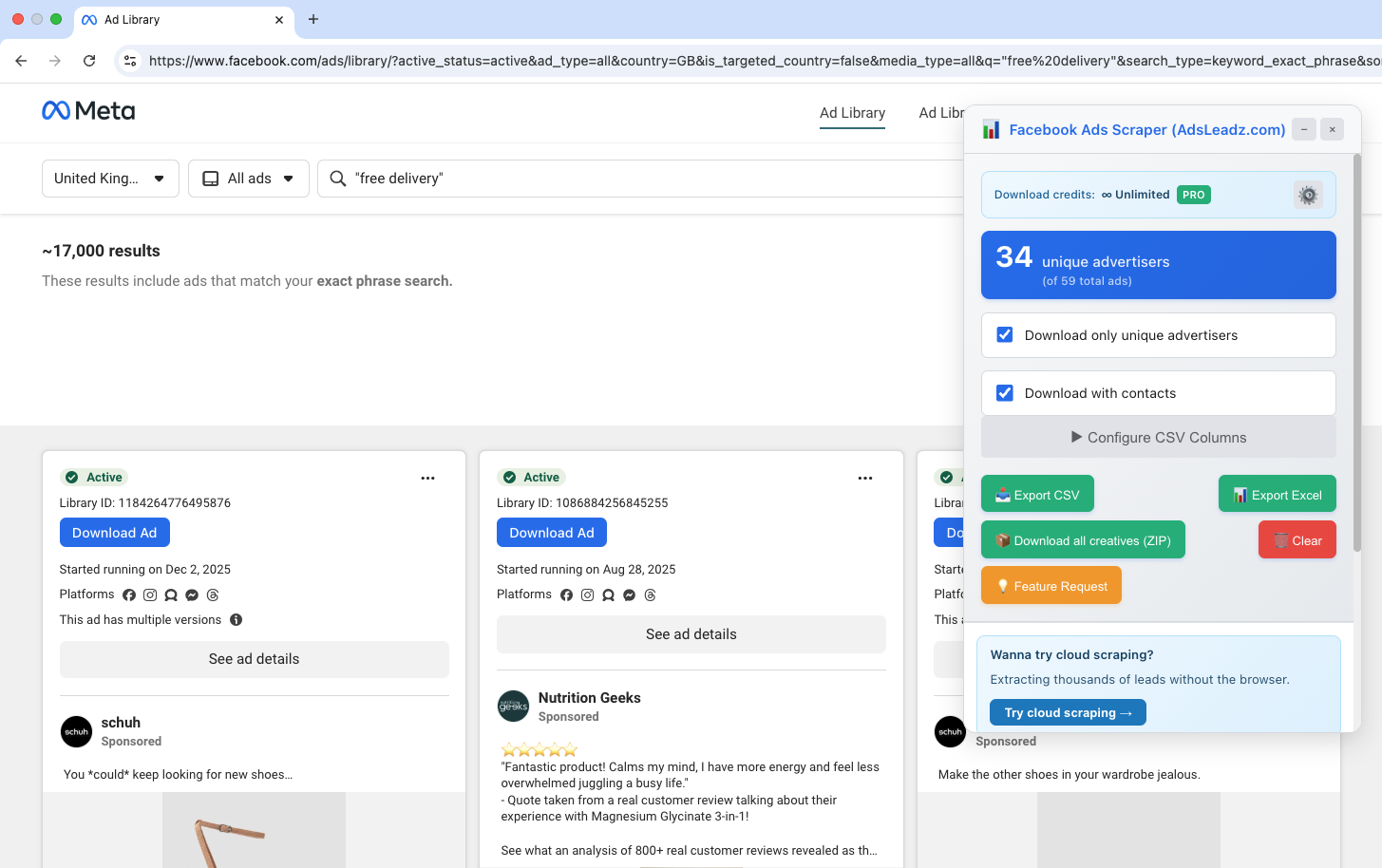
AdsLeadz helps agencies extract structured advertiser data directly from the Ads Library.
Instead of manually searching, agencies can filter by active ad count, detect similar ad clusters, export contact info (emails, websites), identify advertiser niche context, and work without strict library UI limits.
Key Advantage Over Generic Scraping
Most scraping tools extract ad data only, with no structured filtering or contact enrichment.
AdsLeadz focuses specifically on advertiser extraction, outreach-ready export, and unlimited Chrome extension usage. This allows agencies to build hyper-targeted outreach lists like: “Beauty brands running 40+ ads in US & UK in last 30 days.” That’s a warm prospect.
Example: Real-World Agency Use Case
Let’s say you run a performance creative agency. Goal: find brands testing heavily in skincare.
Process: Filter beauty niche, sort by 30+ active ads, check similar ad count, export contact emails, send personalized outreach referencing specific creatives.
Instead of: “We can scale your ads”
You send: “I noticed you’re testing 18 variations of your Vitamin C serum hook. We recently helped a similar brand reduce CPA by 27% by restructuring creative angles.”
That gets replies.
Comparison: Manual vs Tool-Based Prospecting
| Method | Speed | Scale | Contact Info | Filtering | Efficiency |
|---|---|---|---|---|---|
| Manual Ads Library | Slow | Low | No | No | Poor |
| Generic Scraper | Medium | Medium | Rare | Limited | Moderate |
| AdsLeadz | Fast | High | Yes | Advanced | High |
How to Prioritize the Best High-Spend Leads
Not every advertiser with many ads is ideal. Here’s a scoring framework agencies use:
| Signal | Weight |
|---|---|
| 50+ active ads | High |
| Multi-country | High |
| 60+ day ads | High |
| Similar creative clusters | Medium |
| Professional landing page | Medium |
| Influencer usage | Medium |
Combine 3+ strong signals = priority lead.
Market Context: Why This Matters in 2026
According to Statista (2025), global digital ad spend surpassed $667 billion. Meta remains one of the top paid channels worldwide.
Competition increased. CPMs increased. Creative fatigue accelerated.
Which means brands spending big are constantly searching for better creative, better buying strategies, and better agencies. The opportunity is not shrinking. It’s consolidating around serious players.
Who This Strategy Is For
Ideal for: Media buying agencies, creative agencies, UGC production teams, AI ad video studios, CRO agencies.
Not ideal for: Freelancers with no case studies, agencies without clear niche focus, cold email beginners blasting generic lists. High-spend advertisers expect sophistication.
Soft CTA
If you’re building outreach around active advertisers instead of random stores, your close rate changes.
Structured Ads Library data gives context. Context creates relevance. Relevance creates replies.
Frequently Asked Questions
Similar Articles

How to Build a Lead List Using Meta Ads Library (2026 Guide)
Step-by-step guide to building a B2B lead list from Meta Ads Library. Learn manual methods, automation tools, and how to extract contacts at scale. ...

How to Find Companies Running Facebook Ads (2026 Guide)
Learn how to find companies running Facebook ads in 2026 using Meta Ads Library, smart filters, competitor research, and automation tools. Step-by-step guide. ...

How an AI Video Ads Agency Can Find Brands Already Testing New Creatives
Learn how an AI video ads agency can find brands already testing new creatives using Facebook Ads Library data, filters, and competitor signals. ...